

Following the news from Europe
Provided by AGP
Designing Industrial Spaces: Insights from a Professional Custom UFO LED Highbay Light Supplier
Why Industrial Lighting Design Fails — The Three Most Costly Mistakes Facility Planners Make
Three planning failures account for the majority of poor industrial lighting outcomes. First, specifiers frequently choose wattage without calculating the relationship between mounting height and delivered lux at the work plane. A 200W fixture at eight meters mounting height produces a fundamentally different illuminance result than the same fixture at fourteen meters — yet procurement decisions rarely reflect this distinction.
Second, many buyers conflate lumen output with useful illuminance. A high-lumen fixture with poor beam control scatters light inefficiently across walls and ceiling, producing low uniformity ratios on the floor where workers and equipment actually operate. Uniformity matters as much as raw brightness in any task-critical environment.
Third, and most financially consequential, facilities consistently optimize for unit purchase price rather than total ownership cost. A fixture priced 20% lower but carrying a shorter effective lifespan or a higher failure rate can generate significantly greater expenditure over a five-year period. Understanding these three failure patterns is the prerequisite for every selection decision that follows.
How to Match UFO High Bay Light Specifications to Ceiling Height and Application Type
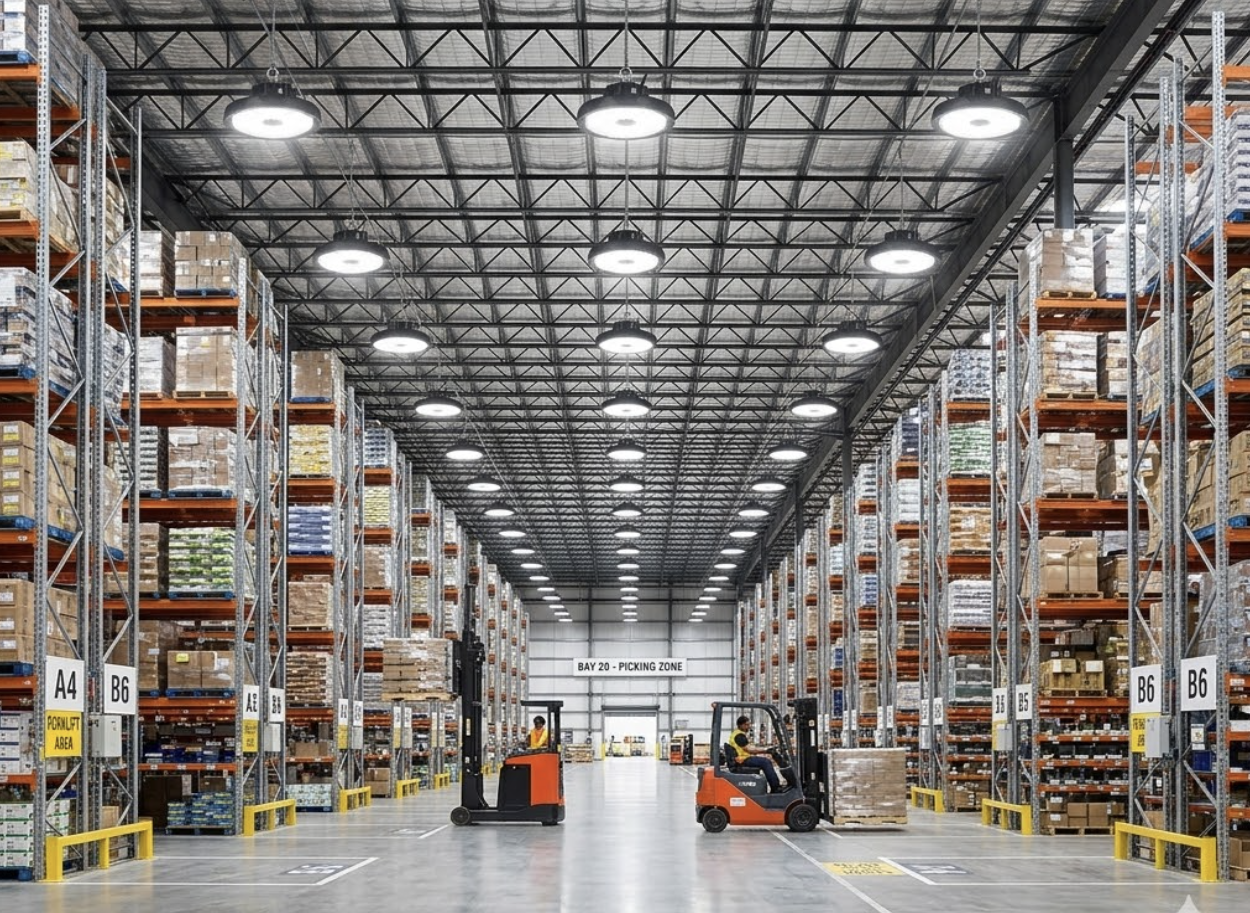
Beam angle is the primary optical variable in high bay selection. Narrow 60° distributions concentrate flux in tall spaces — typically above ten meters — where a tight beam column maintains adequate lux levels at the work surface despite the vertical distance. Mid-ceiling manufacturing floors and retail warehouses generally perform better with 90° distributions, which balance vertical throw with lateral spread. Spaces below six meters, such as parking areas or lower-bay storage, benefit from 120° wide-angle coverage that minimizes shadowing between racks or vehicles.
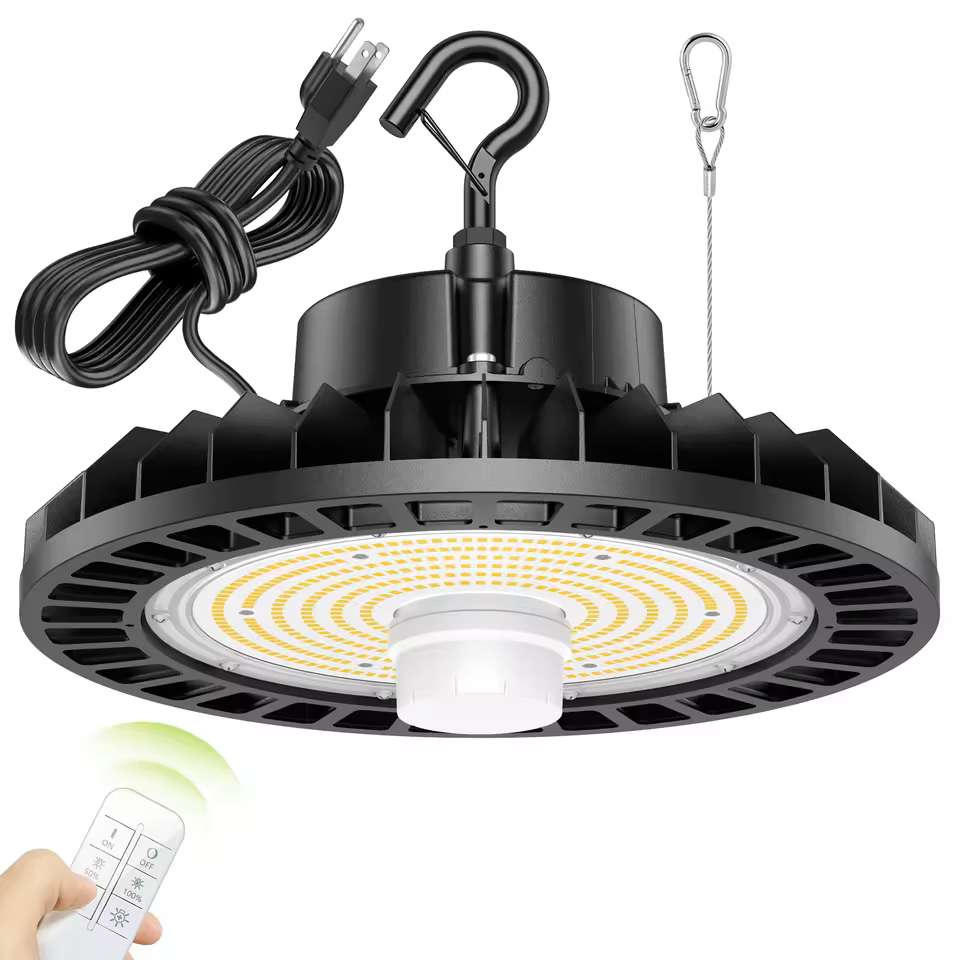
Starslighting's UFO high bay range addresses this directly. The ST-H001 dimmable series and ST-H004 economic series both offer beam angle options across 60°, 90°, 120°, T2, T3, and T4 distributions within the same 100W to 240W power bracket. This flexibility allows a single product family to serve a logistics center's primary storage zone, its receiving dock, and its lower-ceiling office annexe — without sourcing separate fixture types for each area. Luminous efficiency across the range reaches 140 to 200 lm/W, depending on driver configuration and chip selection.
The Dimming Decision — When Adaptive Output Control Moves from Optional to Essential
Fixed-output fixtures serve single-shift, constant-occupancy environments well. The calculus changes significantly in multi-shift operations, cold storage facilities, and food processing plants — environments where occupancy patterns vary substantially across a 24-hour cycle.
In these contexts, 0-10V dimming, PIR motion sensing, and remote control capability shift from optional upgrades to operationally justified investments. A logistics facility running at 30% occupancy during off-peak hours can reduce lighting energy draw proportionally without compromising safety illuminance at active zones. Time-based scheduling further automates this without requiring manual intervention.
Starslighting's ST-H001 and ST-H005 higher quality dimmable series support 0-10V dimming, time control, ambient light sensor integration, and optional PIR or remote controller configurations. Notably, the ST-H001 accommodates multiple driver architectures — DOB, linear, non-isolated, and isolated — allowing the control mode to match the facility's existing electrical infrastructure rather than requiring system modifications. For cold storage applications, both series maintain rated performance down to -40°C, a threshold that eliminates a common point of failure in refrigerated warehouse installations.
Thermal Management and Driver Selection — The Engineering Details That Determine Long-Term Performance
A fixture's rated lifespan of 50,000 hours reflects laboratory conditions. Real-world performance depends on thermal management quality — specifically, how effectively the housing dissipates heat generated at the LED junction under sustained operation.
Die-cast aluminum housings with optimized fin geometry move heat away from the LED board efficiently. This thermal pathway directly affects lumen maintenance over time. A fixture that holds 90% of its initial output at 25,000 hours performs very differently from one that drops to 70% under the same operational conditions, even if both carry identical initial specifications.
Driver selection carries comparable weight. Meanwell, Philips, Inventronics, and Sosen each bring distinct reliability profiles and warranty structures. Non-isolated drivers typically offer higher efficiency in controlled environments. Isolated architectures provide better protection against voltage irregularities in industrial settings with variable power quality. Changzhou Starslighting Technology Co., Ltd. configures driver sourcing across all major brands within its high bay range, giving buyers meaningful control over the quality tier matched to each project's budget and reliability requirements. PC lens material protects the optical assembly from dust ingress and UV degradation while maintaining stable beam geometry across the fixture's operational life.
Navigating Certification Requirements for Industrial Facilities Across Different Jurisdictions
Compliance requirements for industrial lighting vary significantly by market. European facilities require CE marking, RoHS declaration, and ERP directive conformity as baseline documentation. Food processing and pharmaceutical environments frequently impose additional IP rating standards — IP65 covers dust and water jet resistance, which both the ST-H001 and ST-H004 series meet. Cold storage applications require verified performance documentation at low-temperature extremes, not just a stated specification.
International procurement adds further layers. North American projects increasingly reference NOM certification for Mexican market access. GCC government tenders demand SASO compliance. Distributors managing multi-market product lines face the practical risk that a certification gap in any single jurisdiction can block an entire shipment or delay project handover.
Starslighting (Changzhou Starslighting Technology Co., Ltd.) maintains CE, CB, RoHS, ERP, ISO, NOM, and SASO certifications across its high bay product range. For procurement teams managing cross-border facility upgrades or distributor networks spanning multiple regulatory environments, this breadth of documentation removes a significant layer of compliance administration from the supplier evaluation process.
The Supplier Evaluation Checklist — What to Verify Before Committing to a High Bay Light Source
Six checkpoints consistently separate capable suppliers from those who underdeliver at project scale. First, in-house photometric testing capability: an integrating sphere and Distribution Photometric Darkroom allow a manufacturer to generate third-party-verifiable lumen and beam data rather than relying on chip manufacturer datasheets. Second, OEM and ODM customization depth: meaningful customization covers lens type, driver brand, CCT selection, housing color, and branding — not just label changes. Third, sample availability and shipping lead time: a reliable supplier dispatches samples within days via standard express channels. Fourth, minimum order quantity thresholds: MOQ of 200 units for standard configurations gives buyers flexibility in project-scale purchasing. Fifth, spare parts commitment: critical components including drivers, lenses, and mounting hardware should remain available for at least five to ten years post-purchase. Sixth, installation support: on-site engineer dispatch for complex installations reduces commissioning risk on large-scale deployments.
Starslighting operates a 3,800 square meter manufacturing facility with an annual production capacity of 200,000 sets. Its engineering team supports full OEM and ODM customization. A dedicated after-sales team manages technical support, warranty claims, and spare parts logistics. In-house production infrastructure includes SMT pick-and-place systems and aging test chambers for production-line quality verification. For facility engineers and procurement managers benchmarking potential suppliers, these operational parameters provide a concrete reference point beyond catalogue specifications.
For product specifications, customization options, and project consultation, visit https://www.czstarslighting.com/.
Changzhou Starslighting Technology CO.,LTD.
Changzhou Starslighting Technology CO.,LTD.
+ +86 17305192737
info@czstarslighting.com
Visit us on social media:
X
Legal Disclaimer:
EIN Presswire provides this news content "as is" without warranty of any kind. We do not accept any responsibility or liability for the accuracy, content, images, videos, licenses, completeness, legality, or reliability of the information contained in this article. If you have any complaints or copyright issues related to this article, kindly contact the author above.
