

Global Synthetic Silica Glass Market Led by Asia Pacific, Corning, Heraeus, Tosoh Drive Demand Growth
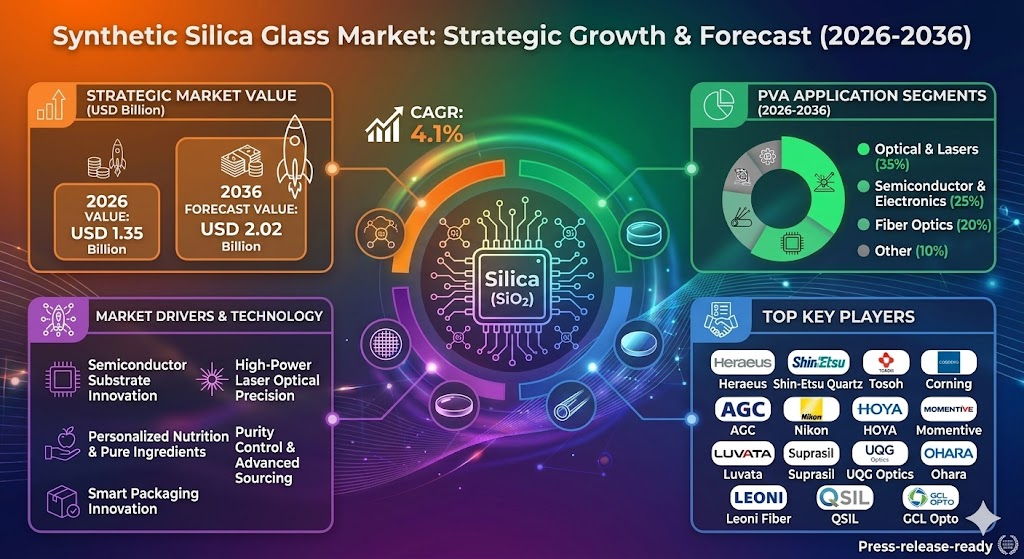
Synthetic Silica Glass Market grows with rising demand in semiconductors, optics, and high-purity industrial applications.
ROCKVILLE, MD, UNITED STATES, April 9, 2026 /EINPresswire.com/ -- According to Fact MR, latest analysis, the global synthetic silica glass market is valued at USD 1.30 billion in 2025 and is projected to reach USD 1.35 billion in 2026, ultimately expanding to USD 2.02 billion by 2036, registering a CAGR of 4.1%. The market is expected to create an incremental opportunity of USD 0.67 billion over the forecast period.This growth is driven by the rapid evolution of semiconductor manufacturing, where advanced nodes below 5nm demand ultra-high-purity materials. Simultaneously, optical communication systems and laboratory-grade applications are accelerating adoption. The transition toward precision-driven manufacturing and cleanroom-grade materials is fundamentally reshaping supplier qualification and procurement strategies.
Get detailed market forecasts, competitive benchmarking, and pricing trends: https://www.factmr.com/connectus/sample?flag=S&rep_id=8816
Quick Stats
Market Size (2025): USD 1.30 Billion
Market Size (2026): USD 1.35 Billion
Forecast Value (2036): USD 2.02 Billion
CAGR (2026–2036): 4.1%
Incremental Opportunity: USD 0.67 Billion
Leading Segment: UV Grade (40% share)
Leading End-use: Semiconductor (45% share)
Leading Region: Asia Pacific (India & China fastest-growing)
Key Players: Heraeus, Shin-Etsu Quartz, Corning, AGC, Tosoh
Executive Insight for Decision Makers
The market is undergoing a strategic shift toward ultra-high-purity, specification-driven materials, where supplier qualification depends on consistency, defect control, and compliance with semiconductor-grade standards.
What stakeholders must do:
Invest in vapour deposition and purity control technologies
Build localized supply chains near semiconductor fabs
Develop application-specific silica solutions for lithography and optics
Risk of inaction:
Failure to meet tightening semiconductor specifications could result in loss of OEM contracts, exclusion from high-margin supply chains, and reduced competitiveness against vertically integrated players.
Market Dynamics
Key Growth Drivers
Rising semiconductor fabrication at advanced nodes
Government incentives (India Semiconductor Mission, CHIPS Act)
Increasing demand for optical fibre and photonics
Growth in precision laboratory and scientific equipment
Key Restraints
High production complexity and capital intensity
Dependence on ultra-pure raw material supply
Pricing pressure from emerging low-cost producers
Emerging Trends
Localization of photomask blank production
Increasing adoption of EUV lithography-compatible materials
Integration of automated quality monitoring systems
Expansion of specialty forms like rods and tubes
Segment Analysis
Leading Segment: UV Grade holds 40% market share, driven by photolithography applications
Fastest-growing Segment: Semiconductor end-use, fueled by fab expansions globally
Breakdown:
By Type: UV Grade, IR Grade, Others
By Form: Rods (35%), Plates, Tubes
By End-use: Semiconductor (45%), Optical Devices, Laboratory
Strategic Importance:
UV-grade silica glass is mission-critical for semiconductor lithography, making it a high-margin, high-entry-barrier segment.
Supply Chain Analysis
Raw Material Suppliers
Silicon tetrachloride and high-purity precursors from chemical companies
Manufacturers / Producers
Specialized quartz glass manufacturers using vapour deposition and flame hydrolysis
Distributors
Technical distributors and direct OEM supply agreements
End-users
Semiconductor fabs
Photomask manufacturers
Optical fibre producers
Scientific instrument companies
Who Supplies Whom
Chemical suppliers → silica glass manufacturers → semiconductor OEMs & optics companies
Integrated players with in-house precursor access gain cost and consistency advantages, while non-integrated players rely on stable upstream partnerships.
Pricing Trends
Market operates as a premium, specification-driven category, not commodity-based
Pricing depends on:
Purity levels (ppb contamination thresholds)
Application (EUV lithography commands premium)
Certification and OEM qualification
Margin Insights:
High margins in semiconductor-grade products
Moderate margins in optical and lab applications
Pricing pressure from Asian entrants affects mid-tier segments
Regional Analysis
Top 5 Countries by CAGR
India – 5.0%
China – 4.5%
Taiwan – 4.0%
USA – 3.8%
South Korea – 3.7%
Regional Insights
Asia Pacific: Fastest growth due to fab expansion and localization
North America: Driven by government-backed semiconductor investments
Europe: Focus on precision optics and advanced manufacturing
Developed vs Emerging
Developed markets: High-value, innovation-driven demand
Emerging markets: Volume-driven growth with infrastructure expansion
Competitive Landscape
Market Structure: Moderately consolidated with strong entry barriers
Key Players
Heraeus
Shin-Etsu Quartz
Corning
AGC
Tosoh
HOYA
Nikon
Momentive
QSIL
Ohara
Competitive Strategies
Investment in purity and process innovation
Strategic partnerships with semiconductor OEMs
Geographic expansion near fab clusters
Advanced product customization
Strategic Takeaways
For Manufacturers
Focus on high-purity production capabilities
Align with semiconductor OEM qualification standards
For Investors
Target companies with fab-linked supply agreements
Prioritize Asia-based expansion strategies
For Marketers / Distributors
Emphasize technical expertise and reliability
Build long-term contracts with fabs and optics firms
Future Outlook
The market is expected to evolve into a critical enabler of next-generation semiconductor and photonics technologies.
EUV lithography and advanced chips will drive demand
Sustainability focus will promote efficient manufacturing processes
Integration with AI-driven manufacturing systems will enhance quality control
Long-term Opportunity:
High-value growth lies in ultra-pure, application-specific silica solutions and localized production ecosystems.
Conclusion
The global synthetic silica glass market is transitioning from a niche materials segment to a strategic backbone of semiconductor and optical industries.
Companies that invest in purity, innovation, and supply chain integration will capture disproportionate value, while others risk commoditization pressures.
Why This Market Matters
Synthetic silica glass is not just a material—it is a mission-critical input enabling the future of electronics, communication, and precision science.
As global economies race toward semiconductor self-reliance and advanced manufacturing, this market will remain central to technological progress and industrial competitiveness.
Unlock 360° insights for strategic decision making and investment planning: https://www.factmr.com/checkout/8816
To View Related Report:
Coenzyme Q10 Market https://www.factmr.com/report/732/coenzymes-q10-market
Medical Superabsorbent Polymers Market https://www.factmr.com/report/739/medical-superabsorbent-polymers-market
Carnauba Wax Market https://www.factmr.com/report/741/carnauba-wax-market
Dimethicone Silicone Market https://www.factmr.com/report/742/dimethicone-silicone-market
About Fact.MR
Fact.MR is a global market research and consulting firm, trusted by Fortune 500 companies and emerging businesses for reliable insights and strategic intelligence. With a presence across the U.S., UK, India, and Dubai, we deliver data-driven research and tailored consulting solutions across 30+ industries and 1,000+ markets. Backed by deep expertise and advanced analytics, Fact.MR helps organizations uncover opportunities, reduce risks, and make informed decisions for sustainable growth.
S. N. Jha
Fact.MR
+ +1 628-251-1583
sales@factmr.com
Legal Disclaimer:
EIN Presswire provides this news content "as is" without warranty of any kind. We do not accept any responsibility or liability for the accuracy, content, images, videos, licenses, completeness, legality, or reliability of the information contained in this article. If you have any complaints or copyright issues related to this article, kindly contact the author above.
