

Sweet Corn Seeds Market Forecast 2026-2036: Projected to Reach USD 2.8 billion by 2035 at 4.5% CAGR
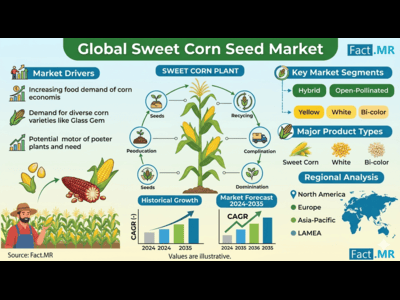
Sweet Corn Seeds Market
Sweet Corn Seeds Market Size and Share Forecast Outlook 2025 to 2035
ROCKVILLE, MD, UNITED STATES, March 23, 2026 /EINPresswire.com/ -- The global agricultural landscape is undergoing a silent but profound revolution. As volatile climate patterns and a burgeoning global population put unprecedented pressure on food supply chains, the Sweet Corn Seeds Market has emerged as a critical frontier for agricultural biotechnology.According to the latest strategic analysis, the market is positioned for a decade of sustained expansion, projected to climb from USD 1.8 billion in 2025 to a commanding USD 2.8 billion by 2035. This trajectory, representing a steady 4.5% CAGR, reflects more than just increased acreage; it signals a fundamental pivot toward high-performance hybrid seed systems that prioritize yield stability in an era of environmental uncertainty.
Get Access Report Sample :
https://www.factmr.com/connectus/sample?flag=S&rep_id=399
The Hybrid Dominance: Why 64% of the Market is Pivoting to Biotech
In 2026, the market reality is clear: traditional open-pollinated varieties are yielding ground to advanced hybrids. Hybrid seeds now command a dominant 64% market share, a figure projected to rise as farmers prioritize crop uniformity and mechanical harvest compatibility.
"We are moving past the era of 'seeds as a commodity' and into 'seeds as a technology platform,'" notes a senior strategist in the sector. The transition is fueled by:
Yield Optimization: Modern hybrids are delivering a 15-25% increase in yield compared to traditional varieties.
Built-in Resilience: Enhanced genetic traits for disease resistance and drought tolerance are no longer premium "add-ons"—they are becoming the baseline requirement for commercial farming.
Food vs. Fodder: While Food applications lead with a 54% share, the livestock sector remains a vital pillar, with Fodder applications accounting for 31% of market demand.
Strategic Imperatives: Designing for Outcomes, Not Just Genetics
For industry stakeholders, the next decade requires a shift in philosophy. Leading players are no longer just selling bags of seeds; they are providing comprehensive "Agricultural Packages."
Precision Agriculture Integration: 2026 marks the year where digital farming becomes the default. Seeds are now being optimized for variable rate seeding and GPS-integrated planting protocols.
Climate-Adapted Genetics: With 15-20% of future revenue expected to come from climate-resilient traits, the focus has shifted to heat resistance and moisture-stress tolerance.
Specialty Markets: The rise of organic and non-GMO premium segments is creating high-margin opportunities for specialty breeders, particularly in Western Europe.
Regional Powerhouses: The USA and Mexico Drive the Pace
The geography of growth is shifting toward regions that combine technological sophistication with expanding agricultural infrastructure.
Country
Projected CAGR (2025-2035)
Primary Growth Catalyst
USA
4.8%
Innovation leadership & high mechanization
Mexico
4.5%
Expanding smallholder access & food processing growth
Germany
4.1%
Sustainable agriculture & organic demand
Japan
3.7%
Precision agriculture & aging farmer support
The United States continues to lead the demand curve, centered in the "Corn Belt" regions of Iowa and Nebraska, where high-tech farming facilities are achieving 78% utilization rates for advanced seed technologies. Meanwhile, Mexico is emerging as a critical expansion zone, as agricultural modernization programs bridge the gap between traditional farming and commercial food production.
The Competitive Frontier: Innovation at the Core
The competitive landscape is consolidating around a core group of R&D-heavy giants who are integrating seeds with digital services. Bayer, Corteva, Syngenta, Limagrain, and Sakata remain the primary architects of the market, collectively holding over 50% of the global revenue.
However, the "Big 5" are facing new competition from regional specialists like East-West Seed and KWS, who are winning over farmers with localized genetics that perform better in specific micro-climates. The battleground has shifted from simple volume to "value-added services," where agronomic support and real-time crop management data are becoming key differentiators.
Strategic Outlook: The Analyst’s View
"The sweet corn seeds market is at a tipping point," states a Lead Agricultural Consultant. "The first half of the decade will focus on the rapid adoption of hybrids to meet basic food security. But the second half—where we see 60% of the decade’s value growth—will be defined by advanced breeding technologies and seamless integration with precision platforms. For investors, the highest potential lies in companies that can solve for 'stress tolerance' without compromising on taste and nutritional profile."
Conclusion: Harvesting Future Opportunities
As the global market moves toward the USD 2.8 billion mark, the opportunity lies in the intersection of biology and data. The next decade will reward those who can provide "weather-proof" crops and data-driven farming solutions. For decision-makers, the message is clear: the future of agriculture is hybrid, digital, and increasingly resilient.
Browse Full Report –
https://www.factmr.com/report/399/sweet-corn-seed-market
To View Related Report:
USA Sweet Corn Seeds Industry Analysis https://www.factmr.com/report/usa-sweet-corn-seeds-industry-analysis
Sweet and Savory Spread Market https://www.factmr.com/report/sweet-and-savory-spread-market
Sweetness Modulators Market https://www.factmr.com/report/sweetness-modulators-market
Sweetness Enhancers Market https://www.factmr.com/report/sweetness-enhancers-market
S. N. Jha
Fact.MR
+1 628-251-1583
email us here
Legal Disclaimer:
EIN Presswire provides this news content "as is" without warranty of any kind. We do not accept any responsibility or liability for the accuracy, content, images, videos, licenses, completeness, legality, or reliability of the information contained in this article. If you have any complaints or copyright issues related to this article, kindly contact the author above.
